Yearly Archives: 2010

Salami and Chili Pepper Pizzas

salami-pizza.jpg

This past fall I rediscovered salami as a pizza topping and I’ve been hooked ever since. It crisps up delightfully around the edges and has a more complex and meaty flavor than pepperoni does. On these individual-sized pizzas, the salami is joined by spicy red chili peppers — you can leave them off if spicy food isn’t you thing, but I find that they add a delicious flavor and negate the need for crushed red peppers added afterward (I usually pile them on). What goes better with salami and cheese than beer? Hannaford sells lumps of beer-bread dough that are perfect to use as the crust for these pizzas (find them in the refrigerated section, near the hummus and fresh mozzarella). Of course, you can use any pizza dough that you like, or make your own beer bread dough from scratch.
.
Because I used a lot of purchased ingredients on these pizzas this post is really more an idea that a recipe, but I hope that it’s one that you’ll enjoy. I figured it would also be a great opportunity to share a few pizza-making tips that I’ve picked up over the years.
red-pack.jpg
Pizza-Making Tips
1) Ditch the jarred sauce. I find most prepared sauced to be too thick, with a much too concentrated tomato flavor. Canned tomatoes have aren’t as overpowering, and have a sweeter flavor that tastes more like a fresh tomato. I usually puree a can of whole peeled plum tomatoes and reduce it on the stove with some Italian seasoning and healthy glug of red wine. Lately though, I’ve just been doctoring a can of crushed tomatoes with some oregano and using that. Red Pack has the perfect texture. (Disclosure: they sent me a few cans to review. I’ve since bought more.)
-
2) Fresh mozzarella, shredded. I love the way fresh mozzarella tastes on pizza, but at lot of places slice it . Since it doesn’t spread as it melts, this leaves big, cheese-less gaps. Shredding the mozzarella will help you cover the entire pizza — overall, you’ll be able to use less cheese, but your pizza will seem cheesier. Throw the mozzarella in the freezer for 15 minutes to firm it up and it will be much easier to shred. The recipe below calls for 6 ounces, but I tend to not use it all.
-
3) Size matters. I know I’ve written about this before, but I prefer to make individual sized pizzas instead of one larger pizza. I have no problem polishing off half of a full-sized pizza. But when I make four individual pizzas, I find that one is enough. And if it isn’t, I’m much more likely to take more salad than I am to grab a second pizza. For me, individual pizzas are crucial for keeping my portions in check. Plus, what’s more fun than your very own pizza?
-
pizza-sliced.jpg

Bruléed Orange Butter Cookies

orange-butter-cookies.jpg

I knew that I needed to bring a knockout recipe to the food blogger cookie exchange that I attended last week, so I turned to these citrusy butter cookies. With a delicate crumb, a texture similar to soft shortbread, and a creme brulée-like smattering of burnt sugar that lightly shatters when you bite into it, Bruléed Orange Butter Cookies are a welcome contrast to the denser oatmeal and peanut butter cookies that are so prevalent this time of year. Although these cookies are a festive treat for the holidays, they make a delightful accompaniment to a cappuccino any time of the year.

icing.jpg brulee.jpg
While the burnt sugar topping is what takes these cookies to the next level, I understand that a kitchen torch isn’t exactly something that everyone has on hand. My first recommendation is to use this recipe as an excuse to get one – they can be found for under $20 and are also great for toasting the cheese on French onion soup. Alternately, you can brown the sugar under the broiler for 45 seconds; however, taking this approach will also melt the glaze and the cookies won’t look quite as pretty. Of course, they are incredible without the crunchy topping – just be sure to let the glaze fully harden (about 2 hours) before stacking them.

bruleed-orange-cookies.jpg

Bruléed Orange Butter Cookies
Yields 3 dozen

For the Cookies:

For the Icing:

2-1/3 cups flour

1/2 cup powdered sugar

1/2 tsp. salt

1 tsp. orange extract

1/4 tsp. baking powder

1 Tbs. heavy cream

8 oz. unsalted butter softened

1 Tbs. water

1 cup granulated sugar

1/2 tsp. orange zest

2 Tbs. orange zest

1 pinch salt

3 large egg yolks

1/8 cup turbinado sugar

1 tsp. vanilla extract

.

.

.

.

.

.

To make the cookies: In a bowl, whisk the flour, baking powder, and salt. In a second bowl, beat the butter, granulated sugar, and zest on medium speed until well blended. Add the egg yolks and vanilla. Mix until blended. Add the flour and mix on until moist clumps form. Wrap in plastic and chill 40 minutes. Roll between two sheets of parchment to ¼-inch thick. Cut with 2-inch cutters. Bake at 350 for 13 minutes or until the edges begin to brown. Allow to cool completely.

To make the icing: Combine remaining ingredients (except turbinado sugar) to form a thin glaze. Spread each cookie with 1/4 teaspoon of the glaze, then sprinkle with turbinado sugar. Pass a kitchen torch over to melt the sugar.

Approx. 110 calories, 6 grams fat, 13 grams carbs, 0 grams fiber, 1 gram protein per cookie

****

I’m linking this post to Wanderfood Wednesday.

Ropa Vieja with Olives and Capers

ropa.jpg

Ropa Veija is a traditional Cuban dish featuring beef that is slowly stewed in a sauce of tomatoes, garlic, and bell peppers until it falls apart into shreds. With the texture of pulled pork and the comforting flavor of pot-roast, Ropa Veija is a real crowd pleaser!

Although it does take a while to make (about 3-1/2 hours), the recipe couldn’t be simpler and it doesn’t require a lot of hands-on time. It’s also the kind of dish that tastes even better the next day, after the flavors have had more time to meld. I like to make a big batch on a lazy Saturday afternoon, then make Ropa and Swiss Sandwiches – a dish I fell in love with at New World Bistro Bar – to eat while we watch football (go Bills!) on Sunday.

ropa-veija.jpg
ropa-and-swiss.jpg

Tortelloni Fagioli with Fire Roasted Tomatoes

tortelloni-soup.jpg

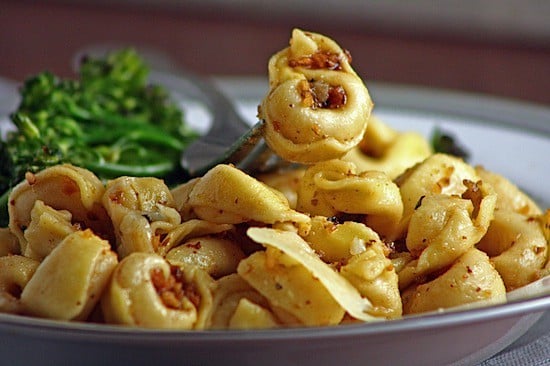
This spin on classic pasta fagioli was nothing more than an excuse eat tortellini.

Seriously. I’ve been craving it ever since I made Tortelloni Di Ricotta Di Noci Tostate but, since I find tortellini so easy to overeat, I try not to make it too often. Then I had a brilliant idea: stretch out a serving of tortellini by adding it to a soup full of nutritious ingredients. As it turns out, the soup that I created ended up being crave worthy in its own right — and is much healthier than just eating a giant bowl of carbs and cheese for dinner (which is what I would have done otherwise).

soup ingredients.jpg

I always say that I like to make soup because it’s so simple, and this is one of the easiest yet — other than chopping an onion, all you have to do is open jars and dump them in your pot. Since there are so few ingredients in this recipe and I wanted to be sure that the final dish was full of flavor, I turned to my old favorite: fire roasted tomatoes. I really love the slightly smokey, charred flavor of these tomatoes and they really added a nice dimension to the soup.

Instead of regular cheese tortellini, I grabbed a package of chicken and proscuitto tortelloni from Buitoni. I LOVED the way these tasted in the soup! They were very delicate but they added a ton of flavor (they reminded me a little bit of wontons). I definitely recommend using them, but if you can’t find them — or if you’re a vegetarian — you can easily substitute regular cheese tortellini.

Kitchen Tip: When using store-bought stock, I always look for unsalted versions. Especially in recipe like this one that use a lot of canned ingredients, sodium levels can add up pretty quickly. Using unsalted stock puts you in control — just add as much (or as little!) salt as you need to make it taste the way you like.

soup-at-the-table.jpg

Let’s Talk Risotto

risotto-rice.jpg

If you’ve hung out around this blog for a while, you know that risotto is a staple in our house. You might even says it’s my thing. In fact, when I was asked to bring a gift that represented my blog to the Foodbuzz Festival I brought a risotto kit.

So when Marx Foods was looking for people to test and review four different kinds of risotto rice, I jumped on the opportunity. I almost always use arborio rice, both because its easy to find and affordable and because its what I know, but I was super excited to try out the rice that Marx Foods sent me: Vialone Nano, Organic Arborio, Organic Integrale (a brown rice), and Organic Carnaroli. Shawn and I did a blind tasting and ended up ranking the rice the exact same way as each other — and the results surprised us!

risotto-notes.jpg

First, the ground rules: In order to keep the results as unbiased as possible, I identified each rice only by the pan that I cooked it in; I didn’t know which was which until the end. I prepared them all at the same time (quite the task!) using a simple recipe that would let the flavor of the rice itself shine through — just the rice, some onion, white wine, and chicken stock. I kept detailed notes as I cooked and tasted and rated each rice on appearance, creaminess, smell, and taste. When Shawn came home from work, he tasted each and ranked his favorites (again, he didn’t know which was which. He also didn’t know that I used the same recipe for each version of the risotto.)

risotto.jpg
Clockwise from top left: Arborio, Carnaroli, Integrale, Vialone Nano

My Thoughts…
.
…On Cooking: I was surprised by how quickly pan #3 (the Integrale brown rice) absorbed the initial stock that I added. It was the first pan to need additional stock added; however after that it was a while before I needed to make a third addition. On the other end, the rice in pan #4 (Vialone Nano) absorbed the liquid very slowly and was the last to need more added. Pan #1 (Arborio) actually took it’s third addition of stock at the same time that the Vialone Nano needed its second! In terms of total absorption, the arborio needed the most liquid added before it was fully cooked. It also plumped up the most and yielded the most volume of all the varieties.
.
The rice all took about the same time to cook, with the exception of the Integrale which needed about 10 minutes longer. One thing to note about the Integrale is that it wasn’t very creamy until the last 5 minutes of cooking — at that time it transformed from a soupy mess into a creamy mass almost instantly! A little patience definitely paid off.
.
…On Appearance: Pan #1 (Arborio) was white and creamy. It looked like I expect risotto to look, which made sense considering it’s the rice I always use. Pan #2 (Carnaroli) was also very white, but was drier and had slightly less volume. Pan #3 (Integrale) was light brown and creamy, and had the least volume. Pan #4 (Vialone Nano) was beige, had a slightly drier appearance than Pan #1, and had a nice amount of volume. In terms of creaminess, I ranked the risottos as follows: Arborio, Integrale, Vialone Nano, Carnaroli.
.
…On Smell: I don’t really know why I tested this one, but I did. The Arborio smelled very delicate and floral. The Integrale smelled earthy like mushrooms. I didn’t notice any discernible scent on the other two.
.
…On Taste: The most important category! Pan #1 (Arborio) resulted in a creamy, chewy risotto. It absorbed the flavor of the chicken stock well, but had the least flavor of the four risottos. It was also very heavy and sticky and created a film in my mouth. Pan #2 (Carnaroli) had a very nice, light flavor. It was less sticky, but not very creamy at all. Major point deduction for the texture, since I like creamy risottos. Pan #3 (Integrale) was very creamy and had the strongest flavor of all the risottos – Shawn described it as being “meaty” and I thought it was mushroomy. It definitely had an earthy quality to it, but it wasn’t immediately obvious that the flavor was that of brown rice. Pan #4 (Vialone Nano) absorbed the flavor of the chicken stock extremely well. It was creamy, but had a little more texture to it and it wasn’t as heavy or sticky as the Arborio.
.
And the Verdict Is?
Shawn and I both ranked our favorites without telling the other, and we both had the same ranking! Our favorite was the Integrale, followed by the Vialone Nano, the Arborio, and then the Carnaroli. It’s important to note though, that while the Integrale was our favorite in the simple preparation, its strong flavor won’t lend itself to all risotto recipes. It definitely needs bold ingredients that can stand up to its earthy flavor! (Think mushrooms, bitter greens, beef…) The Vialone Nano is more of an “all purpose” risotto that can be used in any preparation.
.
So what are you waiting for? Let’s get cooking! Here are some of my favorite risotto recipes that I’ve posted in the past:
. Roast Steelhead with Citrus and Olives over Saffron Risotto (psst — there’s still time to make this recipe and blog about it for a chance to win $100! See Kitchen-Play.Com for details.)

Tandoori Rotis (Indian Flat Bread)

tandoor-roti.jpg

Now that you’re all set to whip up some chana masala next time you’re looking for a quick, nutritious meal you need something to serve it with, right? Enter tandoori rotis.

Crispy on the outside and soft and chewy on the inside, these breads are perfect for sopping up curries and sauces. They’re also a great accompaniment to soup! No yeast means they’re quick to make (no long rise times required) and the ingredient list couldn’t be simpler — you probably have everything you need to make them in your cabinet right now.

Tandoori rotis are traditionally baked in a clay oven called a tandoor, but they can also be made successfully in a regular oven. Just like with pita bread, rotis puff up when the moisture in the dough turns to steam. Because of this, you’ll want to be sure your oven is nice and hot — allow plenty of time for it to preheat. I like to bake mine on a pizza stone, but a heavy duty baking sheet will work just as well. I also like to use a combination of white, whole wheat, and garbanzo beans flours in my rotis because it keeps them nice and light while giving them a great nutty flavor. If you prefer, they can also be made with all whole wheat flour or with a mixture of half white and half whole wheat.

Ready to take your bread making skills to the next level? Try my pea & herb stuffed naan.

tandoor-roti-2.jpg
I’m submitting this post to WanderFood Wednesday